

Introduction
Poka yoke, the error-proofing methodology developed by Shigeo Shingo at Toyota, has been applied in manufacturing for over six decades. Despite its age, it remains one of the highest-ROI quality improvement tools available. A 2024 iGrafx lean manufacturing study found that manufacturers who implement structured poka yoke programs reduce their defect rates by an average of 62% within twelve months. These twelve examples come from automotive, electronics, medical device, and FMCG production environments.
What is poka yoke and how does it work in practice?
Poka yoke is a manufacturing technique that makes it physically impossible or immediately detectable when a human operator makes an error. Unlike inspection-based quality control that catches defects after they occur, poka yoke prevents defects from occurring in the first place. The mechanism can be physical, such as a fixture that only accepts a part in the correct orientation, or sensory, such as a light that activates when an operator skips a required step.
Shingo classified poka yoke into two types: control devices that stop the process when an error is detected, and warning devices that alert the operator without stopping the process. Control devices are preferred for safety-critical or high-defect-cost operations. Warning devices are used where stopping the process is more costly than the defect itself.
Twelve poka yoke examples across manufacturing industries
First: asymmetric connectors in electronics assembly. USB-A connectors can only insert one way because the housing is asymmetric. This prevents reverse polarity damage without any training requirement. Second: weight-based completion sensors in automotive assembly. A scale under the parts tray alerts the operator if they attempt to advance to the next station without removing all required fasteners. Third: color-coded fluid ports in automotive engine assembly. Coolant, oil, and fuel ports use non-interchangeable fittings designed so the wrong hose cannot physically connect.
Fourth: template jigs in sheet metal fabrication that position holes only where drilling is required, making it impossible to drill in the wrong location. Fifth: proximity sensors on pharmaceutical blister packing lines that verify each blister cavity contains a tablet before sealing. Sixth: barcode-verified kitting systems in aerospace that cross-reference every part removed from storage against the work order before the part reaches the assembly station.
Seventh: light-guided assembly systems that illuminate the correct bin in sequence, so operators pick components in the right order. Eighth: force-monitoring torque tools that lock out if the correct torque value was not achieved on the previous fastener. Ninth: vision-based presence-absence checks at assembly completion that verify all required components are installed before the pallet releases.
For a deeper look at how these poka yoke examples in manufacturing translate into measurable defect reduction, the full case study breakdown covers implementation cost and payback period for each category.
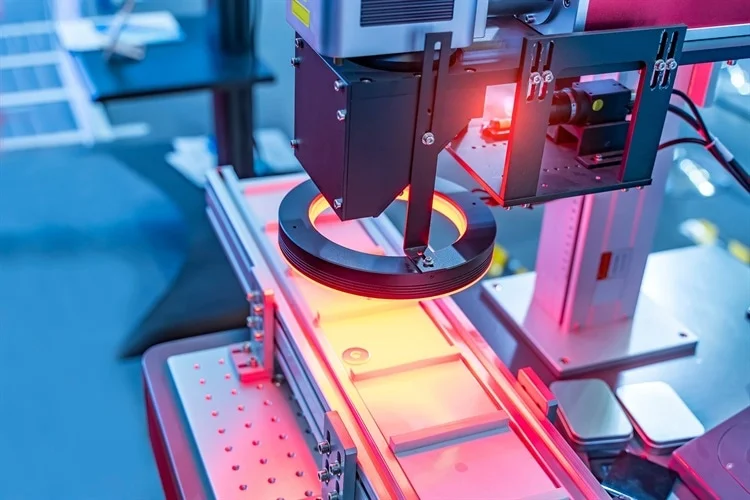
Tenth: shaped trays for surgical kit assembly in medical devices where instruments only fit in their designated holder, making it impossible to complete the tray with a missing or substituted instrument. Eleventh: photoelectric sensors on FMCG filling lines that detect underfill or overfill before capping, rejecting bottles automatically without operator intervention. Twelfth: fixed-position laser markers on injection mold parts that burn a traceability code only when the part is correctly seated in the marking fixture.
How do AI visual inspection systems extend poka yoke into complex defect categories?
Classical poka yoke handles binary errors: part present or absent, correctly oriented or not, fastener torqued or not. It cannot handle defects that exist on a spectrum, such as a weld seam that is 80% correct versus 100% correct, or a surface scratch that is within tolerance versus out of tolerance. AI visual inspection extends the poka yoke principle into these continuous-value defect categories by providing real-time, quantitative quality gates at each inspection point.
AI inspection systems act as digital poka yoke devices for defect categories that are too complex for mechanical error-proofing. The system stops the line or rejects the part when defect severity exceeds the threshold, just as a mechanical poka yoke prevents a part from advancing when it is incorrectly assembled. The operator receives the same type of feedback: the process stops, and the reason is displayed.
Frequently Asked Questions
How much does it cost to implement poka yoke in a manufacturing facility?
Simple mechanical poka yoke devices such as asymmetric fixtures and shaped trays cost $50 to $500 each. Sensor-based systems cost $1,000 to $10,000 per station. Light-guided assembly systems run $5,000 to $30,000 per workstation. Payback periods range from three to eighteen months depending on defect rate and defect cost.
What is the difference between poka yoke and statistical process control?
Poka yoke prevents individual defects at the point of occurrence. Statistical process control monitors process variation over time to detect drift before it produces defects. Both systems are complementary: poka yoke handles known error modes, and SPC detects new error sources before they exceed the poka yoke device’s detection threshold.
Conclusion
Poka yoke remains one of the most cost-effective quality improvement tools in manufacturing because it prevents defects rather than detecting them after the fact. The twelve examples above cover the most common implementation patterns across industry types. Start with the highest-frequency, highest-cost defect categories on your line and design mechanical or sensory error-proofing that makes the error physically impossible or immediately visible.
Ready to see AI visual inspection in action on your production line? Request a Jidoka Tech demo and get a defect detection assessment tailored to your product and line speed.